

Steel warehouse cost per square foot 2026
Steel Warehouse Cost Per Square Foot: 2026 Price Guide
A steel warehouse prices two ways in 2026. From a Chinese fabricator the material package runs 4.80 to 10.50 USD per square foot FOB. After US duty and freight that becomes 9 to 20 USD landed. A US pre-engineered building kit runs 13 to 26 USD per square foot, and an erected shell 18 to 38. The pre-2025 gap has closed: at a 75 percent stacked duty, importing is now an engineering and scope decision, not a price shortcut. This page sets out the arithmetic by size, tonnage and adder, using our 2026 quotation book and published US supplier ranges.
What a Steel Warehouse Costs Per Square Foot in 2026
Four sizes cover most first enquiries: 40x60, 60x100, 100x150 and 200x200. The table below is our supply-only range for each, priced at the point the container leaves the factory, plus the landed range once ocean freight and US duty are paid. The last column is a reference range for a comparable US pre-engineered metal building package, material plus erection, which is what most American contractors quote.
| Footprint | Frame tonnage | FOB China, supply only | Landed US, duty paid | US kit only | US erected shell |
|---|---|---|---|---|---|
| 40 x 60 ft, 2,400 sq ft | 8 to 11 t | 7.50 to 10.50 | 14 to 20 | 14 to 26 | 18 to 38 |
| 60 x 100 ft, 6,000 sq ft | 17 to 23 t | 6.50 to 9.00 | 12 to 17.50 | 14 to 24 | 18 to 36 |
| 100 x 150 ft, 15,000 sq ft | 38 to 50 t | 5.50 to 7.50 | 10.50 to 14.50 | 13 to 20 | 17 to 32 |
| 200 x 200 ft, 40,000 sq ft | 95 to 125 t | 4.80 to 6.50 | 9 to 12.50 | 13 to 18 | 17 to 30 |
All figures in USD per square foot. The landed column assumes the 75 percent stacked duty now applied to Chinese fabricated structural steel, plus ocean freight. US kit and erected shell ranges reflect published 2026 supplier price guides, not a single national index.
Three things stand out. The FOB price falls as the building grows, because fixed design, detailing and container costs spread across more area. The landed price falls faster than the FOB price, because duty is a percentage and the freight per square foot shrinks with volume. And the gap between landed Chinese steel and a US kit is now narrow enough that freight timing, duty risk and erection supervision decide the deal, not the steel price alone.
A wide span, a heavy snow load or a 150 mph coastal wind raises every column, Chinese and American alike. A published kit range is a starting point, never a quote for your address.
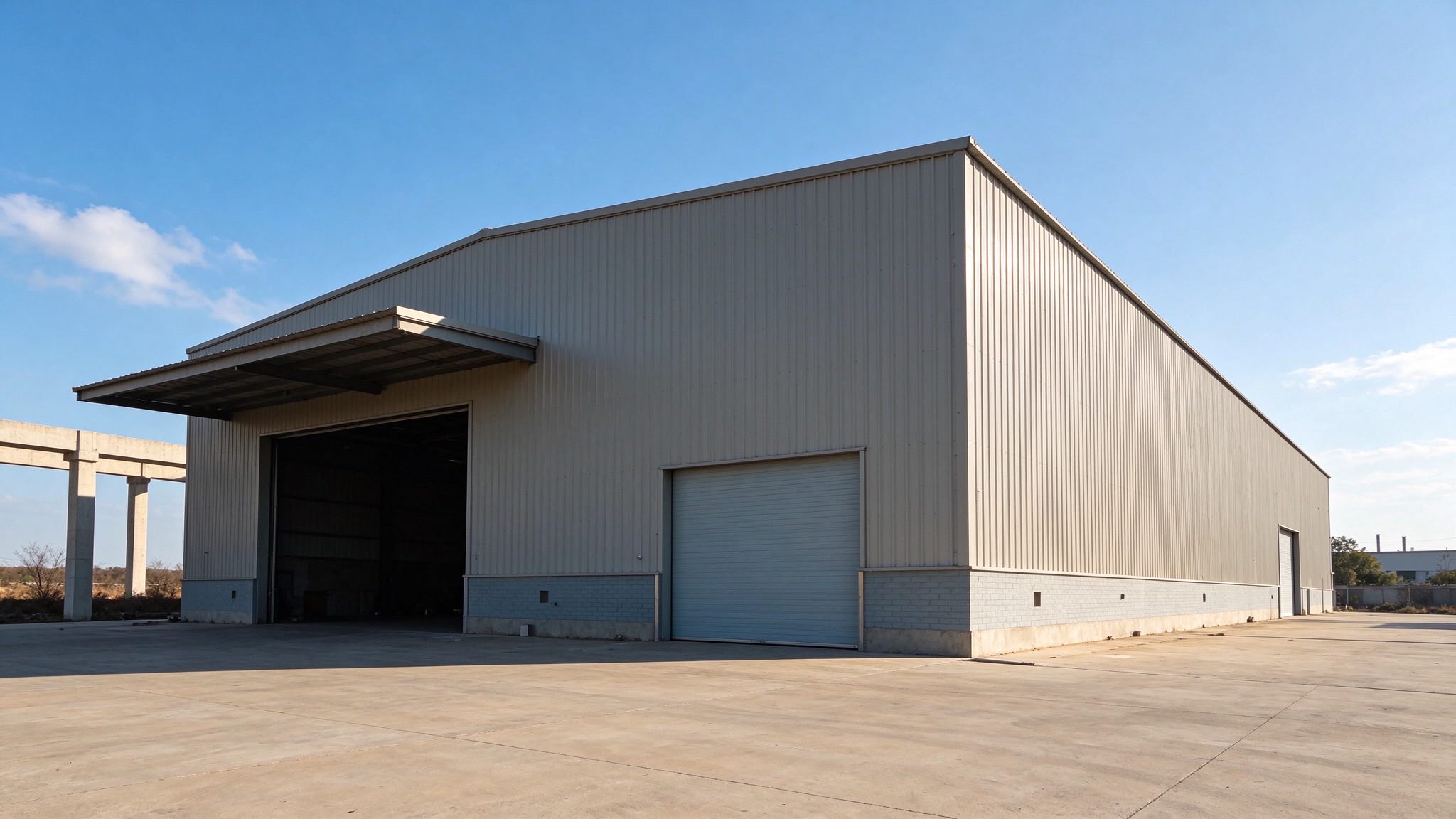
The Four Numbers That Decide Your Price
Every quotation we issue moves on four variables, and three are fixed in the first conversation. That is why the first drawing matters more than the tenth negotiation round.
Bay spacing. A 6 m bay needs more frames per metre of length than an 8 m bay; a 9 m bay cuts the frame count again but raises the individual member weight. For a 60 ft width, the cheapest configuration in our book is usually a 20 ft bay with a 30 ft end span, giving three bays across 60 ft with the fewest possible columns.
Eave height. Going from 6 m to 9 m adds roughly 12 to 18 percent to frame weight and 8 to 14 percent to wall cladding area. Height buys stacking capacity, loading dock clearance and crane clearance, and it is never free.
Frame tonnage. This is the number that actually gets priced. Fabricated frames leave our shop at 900 to 1,250 USD per tonne depending on coating and connection detail. At 6 lb per sq ft, that is roughly 2.45 to 3.55 USD per sq ft of building, which is the floor under every other number on this page.
Cladding specification. Single skin 0.5 mm sheet, 50 mm EPS sandwich panel and 100 mm rock wool panel differ by a factor of two in material cost, and by more than that in what the building does for you in winter.
Frame Tonnage: The Only Cost Driver You Cannot Negotiate Later
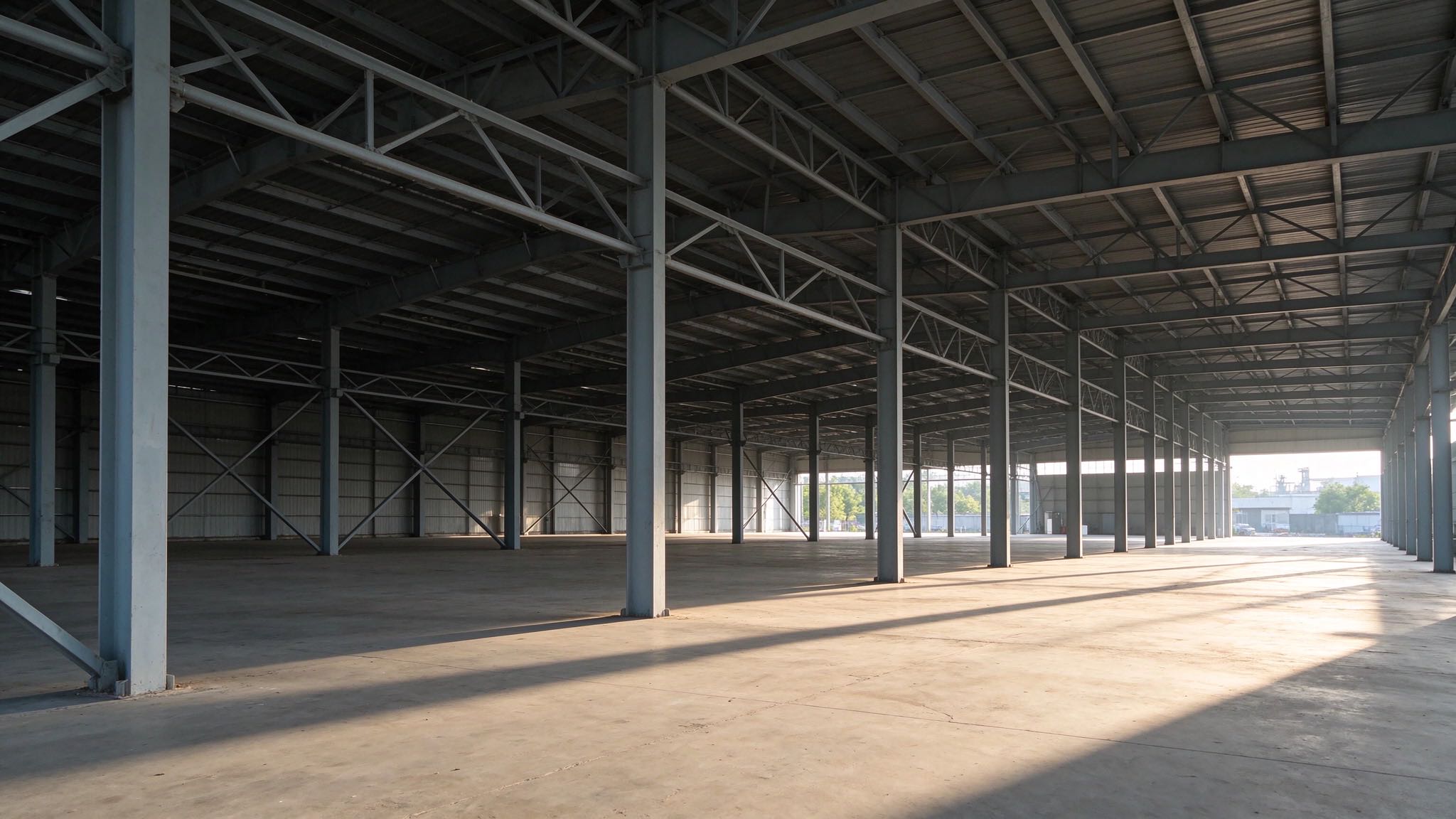
Tonnage is set by span, bay, height, roof load and wind load. Once the frame is fabricated, a later change means cutting, splicing or scrapping members. Buyers who trim tonnage to hit a target price usually discover the cost three months later, in a redesigned foundation or a failed permit review.
| Footprint | Typical frame | Pounds per sq ft | Where the weight goes |
|---|---|---|---|
| 2,400 sq ft | 8 to 11 t | 7.3 to 10.1 | Short spans carry relatively more end frame and bracing per square foot |
| 6,000 sq ft | 17 to 23 t | 6.2 to 8.4 | Purlin runs dominate; bay count starts to pay off |
| 15,000 sq ft | 38 to 50 t | 5.6 to 7.3 | Long internal runs, fewer end frames per unit area |
| 40,000 sq ft | 95 to 125 t | 5.2 to 6.9 | Frame weight approaches the structural minimum for the span set |
A buyer who is quoted 5 lb per sq ft on a 2,400 sq ft building should ask what was left out. Usually it is bracing, a heavier end frame, or the crane beam that was in the original brief.
Price by Size: Four Worked Examples
40 x 60 ft, 2,400 sq ft. Frame around 9 t, single skin cladding, one 3 x 3 m sliding door, no insulation. Supply-only lands near 21,000 to 25,000 USD, or 8.75 to 10.40 USD per sq ft. Landed with 75 percent duty and freight, 39,000 to 47,000 USD. This is the size where per-square-foot pricing is most misleading, because the fixed costs are spread over very little area.
60 x 100 ft, 6,000 sq ft. Frame around 20 t, 50 mm EPS wall and roof panels, two doors. Supply-only near 39,000 to 54,000 USD, or 6.50 to 9.00 USD per sq ft. Freight for this volume is typically three 40 ft high-cube containers, which is the point where container planning starts to matter as much as steel price.
100 x 150 ft, 15,000 sq ft. Frame around 44 t, 100 mm rock wool roof, single skin walls, four doors, one 5 t crane runway. Supply-only near 82,000 to 112,000 USD before the crane adder. Without the crane the same shell sits at the lower end of the band.
200 x 200 ft, 40,000 sq ft. Frame around 110 t, mixed cladding, six doors, two mezzanines. Supply-only near 192,000 to 260,000 USD. At this size the quotation is driven by the member schedule, not by a rate per square foot, and any supplier quoting a single rate is guessing.
Delivered, Landed or Installed: Three Prices Buyers Confuse
Delivered material, FOB China. The container is loaded at our works. The buyer owns freight, insurance, duty and port handling. This is the first price column above.
Landed, duty paid. The container clears US customs. Two charges sit between FOB and landed: duty and freight. Duty on Chinese fabricated structural steel is now 75 percent of the full customs value, made up of the 50 percent Section 232 rate stacked with the 25 percent Section 301 rate, plus any anti-dumping or countervailing duty that covers the specific product. Freight is 1,500 to 2,800 USD per 40 ft high-cube container, and a container carries roughly 27 t of nested frame. At 6,000 sq ft and 20 t, that is three containers and 4,500 to 8,400 USD, or 0.75 to 1.40 USD per square foot.
Worked example. A 6,000 sq ft shell at 8.00 USD per square foot FOB is 48,000 USD. Duty at 75 percent adds 36,000 USD. Freight adds about 6,000 USD. Landed total is 90,000 USD, or 15.00 USD per square foot. A US kit for the same footprint lists at 84,000 to 102,000 USD. The two numbers are level. The US kit carries local engineering stamps and a domestic warranty; the import carries a duty bill, a 25 to 40 day ocean leg and a crew sourced separately.
Installed. A crew erects the structure on a prepared foundation. US erection labor alone runs 4 to 12 USD per square foot for a simple shell, and the slab adds 5 to 9. A finished shell with insulation and doors lands at 30 to 45 USD per square foot, and a full turnkey facility with MEP, sitework and permits at 80 to 150.
The rule: compare like with like. A Chinese FOB quote at 7 USD and a US turnkey quote at 52 USD are not competing offers, and a landed number against a kit with no duty line is the same mistake.
Adders That Move the Number
Adders are where a budget doubles unnoticed. The table lists the ones that appear in almost every real project, priced as supply-only additions to a base shell.
| Adder | Typical supply cost | What it changes structurally |
|---|---|---|
| 5 t crane runway | 1.20 to 2.00 USD per sq ft | Columns and runway beams sized for vertical and lateral wheel loads |
| 10 t crane runway | 2.00 to 3.20 USD per sq ft | Heavier columns, deeper beams, larger foundation reactions |
| Light mezzanine, 500 sq ft | 6 to 9 USD per mezzanine sq ft | Secondary framing, floor deck, stair and edge protection |
| R-19 wall and roof insulation | 0.90 to 1.40 USD per sq ft | Panel depth and weight, not the frame |
| R-30 roof insulation | 1.40 to 2.00 USD per sq ft | Thicker panel, longer fasteners, revised wall junction detail |
| 3 x 3 m overhead door, supply | 700 to 1,100 USD each | Header beam and jamb framing at every opening |
| Fire rated coating | 0.80 to 1.60 USD per sq ft | Intumescent or board protection, surface preparation, inspection |
Doors are the cheapest line item and the most expensive mistake. Every opening interrupts the frame and the cladding run, and a door added after fabrication costs a header beam, a jamb set and a re-detailed wall panel at many times the door price.
Where Per-Square-Foot Pricing Misleads You
A rate per square foot assumes a shape. Three shapes break it.
Small buildings. Below about 3,000 sq ft, fixed costs dominate: design, detailing, container fill and the minimum frame set. A 2,400 sq ft warehouse at 9 USD per sq ft is not expensive; it is small.
Long narrow buildings. A 30 x 200 ft building has the same area as a 77 x 77 ft building and roughly 40 percent more perimeter. More wall, more cladding, more bracing, higher rate.
High bay and multi-level. Height and mezzanine loads are priced per square foot of floor, but the frame works per unit of height. A 12 m eave warehouse quoted at a 6 m rate is a loss for the supplier and a surprise for the buyer at the first revision.
Duty, Freight and the Landed Cost Trap
A landed price in 2026 is not the ship quote plus a container. Three variables decide it, and all three move.
Duty treatment. Chinese fabricated structural steel entered in 2026 pays a 50 percent Section 232 rate stacked with a 25 percent Section 301 rate, assessed on the full customs entry value rather than on metal content alone. That is 75 percent before freight. Anti-dumping and countervailing duties come on top wherever an order covers the product, and the rate depends on the exporter of record. Rates are scheduled to move again in January 2027, so price the duty at the upper end and get a broker ruling on the HTS classification in writing before you compare landed quotes.
Container fill. A 40 ft high-cube holds roughly 28 to 30 t of fabricated frame if the members nest well, and considerably less if they do not. Bad nesting adds containers, and a container is a fixed cost whether it is full or half empty.
Destination. Inland rail from a West Coast port to a Midwest site can add more than the ocean leg. A quote that names a port but not a delivered site address is not a landed quote.
For a longer treatment of the schedule side, see our guide to steel warehouse lead times. For the metric version of this cost breakdown, read cost per square meter.
Verification Checklist Before You Sign
Twelve items decide whether the number survives to the invoice. Ask in writing.
- The member schedule with tonnage per member group, not a total weight.
- The design code and load cases, stated as IBC and ASCE 7 with the site wind and snow values.
- Whether the foundation design is included, and who is responsible for it.
- Cladding thickness in mm, coating class and panel core, named by product.
- Connection bolts, anchor bolts and whether they are included.
- Container count, nesting plan and the port of loading.
- The duty classification the shipper expects, and who pays if it changes.
- Erection scope: supply only, supervision, or full erection.
- Coating system and salt spray hours for the environment at the site.
- Lead time measured from deposit to loading, and from loading to arrival.
- What happens if a member is damaged in transit.
- The revision that triggers a price change, stated as a date or a drawing number.
How Derun Prices a US Warehouse
We quote from the drawing, not from a rate card. A complete enquiry means the footprint, eave height, bay preference, roof and wall specification, door schedule, crane or mezzanine loads, site location for wind and snow, and the delivery port. With those seven items we return a member-based quotation, usually inside two working days.
What we do not include by default: foundation design and slab, US permits and inspections, erection labor, electrical and plumbing, and inland transport. We name those exclusions on every quote so that the comparison against a US turnkey number is honest.
We have shipped warehouse shells to the US, Indonesia, Tanzania and the Philippines, and the two things that go wrong most often are scope confusion and late door changes. Our product page lists the standard configurations: steel structure warehouse. If you are still deciding between materials, our comparison of steel and concrete warehouses covers the lifecycle arithmetic.
Importing still makes sense in three cases: a geometry a US kit supplier will not engineer, such as a 60 m clear span or a hangar door load; a buyer who wants frame, cladding and accessories from one fabrication contract; and a destination outside US duty scope, where the material still prices below local fabrication in most markets. A foreign trade zone entry can defer the duty, but it does not remove it.
Outside those three, a US kit is usually the shorter and safer route, and we tell US buyers so before they take a deposit.
Frequently Asked Questions
Is the price per square foot lower for larger buildings?
Yes, down to about 40,000 sq ft. Fixed costs spread across more area and frame weight per square foot falls toward the structural minimum. Below 3,000 sq ft the fixed share dominates and the rate rises sharply.
What does a supply-only quote from China include?
Fabricated frame, purlins, bracing, cladding, insulation if specified, fasteners, connection bolts and the packing list. It excludes ocean freight, duty, inland transport, foundation, erection, permits and any local code certification work.
How much does a 40x60 steel building cost?
In our 2026 book, 21,000 to 25,000 USD supply only at the factory. With 75 percent duty and freight, landed runs 39,000 to 47,000 USD. A US kit for the same footprint lists at 33,600 to 62,400 USD, and a US erected shell at 43,000 to 91,000 USD before the slab.
Do US tariffs apply to a Chinese steel structure?
Duty treatment depends on classification and on the current measures in force. It can add a large share to the landed cost. Have your customs broker classify the shipment and give you a written ruling before you compare landed quotes.
Can you deliver to a US port and who erects it?
We deliver to a named port, and the buyer arranges inland transport and erection. We can supply an erection supervisor and a bolt-by-bolt sequence if the local crew has not built this system before.
How long from order to arrival?
Fabrication is typically 35 to 50 days for a standard shell, longer with cranes or mezzanines. Ocean transit to a US port adds 25 to 40 days, and inland delivery depends on distance from the port.
What drawing do you need for a firm number?
A plan with overall dimensions, eave height, bay layout, door and window positions, and any crane or mezzanine loads. A hand sketch with those dimensions is enough to quote; a stamped drawing is needed before fabrication.
Why does your metric page quote different numbers?
It prices per square metre for buyers in metric markets, with metric cladding and panel standards. The conversion is not a straight multiply, because panel widths, container fill and duty routes differ by destination.
Next Step: Send the Drawing
Before you commit to a budget, send the footprint, the eave height, the door schedule and the site location. Our engineers check the bay layout, the frame tonnage and the container plan, and return the governing dimensions and an indicative price per square foot, usually within two working days, with no obligation and no sales call. If the layout will not carry the load you described, we say so before you spend on design.
If you already have a drawing, send it on WhatsApp with the footprint, eave height and site location. A one-page sketch with dimensions moves faster than a full architectural set without them.